Fly an FPV drone through a desert canyon, raymarched in the browser
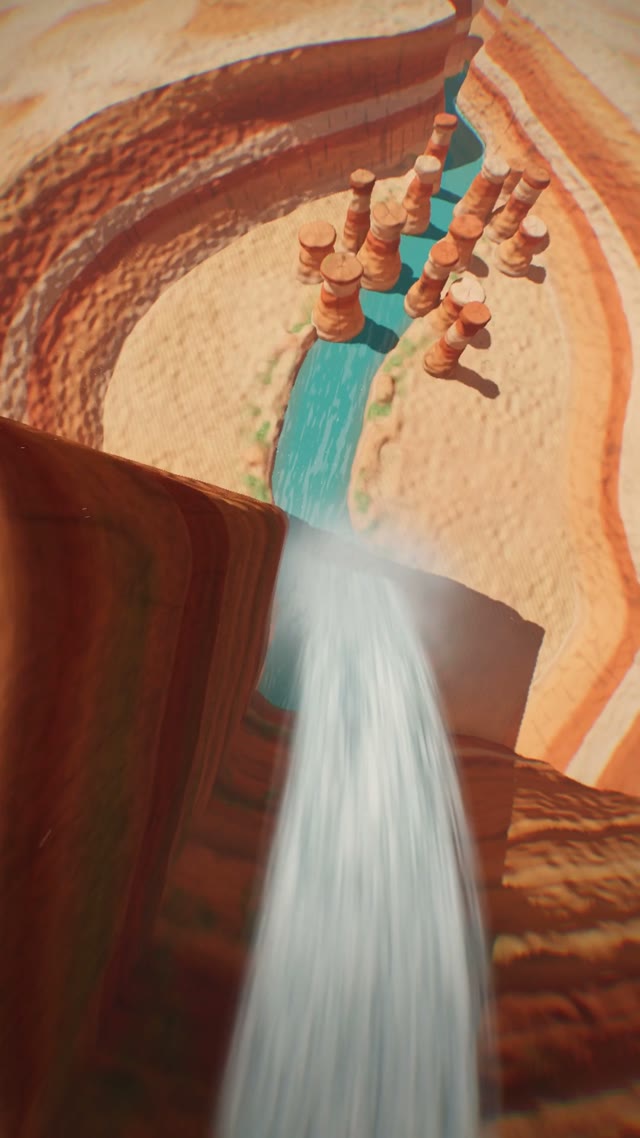
One unbroken first-person drone run through a sunlit red-rock canyon, flown like a cinematic FPV showpiece. The drone hangs beside the top of a waterfall, dives down the cliff with the water falling beside it, pulls out over a jade plunge pool, threads a stand of hoodoos, carves through a slot canyon at 130 km/h under a chockstone and a natural arch, punches through a waterfall curtain at the end of a rock tunnel, and glides out level over the next valley before settling back where it started. The speed comes from proximity and parallax; the horizon stays nearly level. There is no drone, no footage and no 3D package: the canyon is a signed distance field traced in a WebGL2 shader inside HyperFrames, the flight is a smoothed spline, and the world is a staircase of identical canyon sections, which is what lets the flight loop seamlessly. You get four exact prompts (terrain, flight spline, FPV camera, water and waterfalls) with a check for each, the complete source and the 20-second Reel,
Before you start
Uses your AI plan
You’ll need
Claude Code
NoNode.js
HyperFrames
GSGSAP
</>HTML, CSS & JavaScript
pupuppeteer-core
FFFFmpeg
What it uses
4 prompts to your coding assistantCounts toward your assistant’s usual allowance. Nothing extra to buy.
The tutorial
Free with an account · 4 steps
Free with an account. Your assistant runs on the plan you already have.
The recipe
4 steps, from nothing to yours.
Every step gives you the action, the exact input (a prompt, settings or a file) and a check to compare your result against the original.
Step 01
Carve the canyon terrain
Step 02
Fly a spline through it
Step 03
Make it an FPV camera, and make it fast enough to render
YoursStep 04
Water, spray and waterfalls, then render
Exactly what the creator used
Claude Code
Any recent version
Node.js
Any recent version
HyperFrames
Any recent version
GSAP
Any recent version
WebGL2
Any recent version
puppeteer-core
Any recent version
FFmpeg
Any recent version
Claude Code — Claude Opus 5.5 (claude-opus-5-5) — wrote every file — your Claude plan
Node.js — 24.x (24.13.1 here) — the HyperFrames CLI and the dev harness — free
HyperFrames — 0.8.74 (npx hyperframes@0.8.74) — check, render (HTML → MP4) — free, runs locally
GSAP — 3.14.2 (jsDelivr CDN) — the one paused timeline HyperFrames seeks — free
WebGL2 — in Chrome (SwiftShader, software) — the raymarcher — free
puppeteer-core — 24.22.3 (tools/ only) — dev snapshots and the clearance probe — free
FFmpeg — any recent build — the Instagram re-encode, contact sheet and loop test — free
Codex or any agent that can write files and run commands works too. No GPU is needed: HyperFrames renders WebGL in software, and this piece was built for that (see step 3).
Provenance: Recorded September 28, 2026, and re-rendered September 29, 2026 after the rendering fix: Claude Code with Claude Opus 5.5 (claude-opus-5-5); GSAP 3.14.2 from jsDelivr; HyperFrames 0.8.74 rendering WebGL2 in Chrome 152 headless shell with SwiftShader at 1080×1920, 30 fps, 21.067 s (632 frames), no audio; the scene traced at 810×1440 and upsampled in the motion-blur pass. The render took 26 min 55 s with 4 workers on a 24-thread machine shared with other agents (beginframe capture, software GPU, HF_DE_STALL_MS=600000); the master is 38.3 MB, and the Reels copy was re-encoded with FFmpeg (libx264, CRF 21, aq-mode 3, maxrate 22M, faststart) to 19.3 MB. check passed with 0 errors and 4 warnings, all Chrome's "GPU stall due to ReadPixels" driver notes (about 11 minutes, with --timeout 180000). Camera (every frame): roll at most 14.6 degrees (mean 4.7 through the run), roll rate at most 30 degrees per second, no scripted rolls. Distance field (tools/lipschitz.js, 20,000 points per region): no rock inside any "safe" sphere in any region except a 0.003% residual of 0.19 m near the headwall base. Whole-video overstep audit (tools/audit.js, every third frame at 0.3 scale): 0.038% of pixels on average, none above 0.2% (before the fix: 0.18%, up to 1.0%). Loop test (Gaussian blur sigma 3, then SSIM, on the master): 0.8496 across the seam (last frame to frame 0) against 0.8519 and 0.8460 for the steps either side, and PSNR 24.42 dB against 24.69 and 24.14; the steps change smoothly on both sides (0.8636, 0.8593, 0.8554, 0.8519 into the seam; 0.8460, 0.8430, 0.8399, 0.8379 out of it). On the Reels copy: 0.8510 against 0.8536 and 0.8480. Numerically, the camera moves 0.2674, 0.2685 and 0.2699 m over the frames either side of and across the seam. Minimum clearance to rock along the flight: 1.53 m. No external images, footage, textures, models or generative-media models were used.
Fly an FPV drone through a desert canyon, raymarched in the browserUses your AI plan
 Claude Code
 HyperFrames